Malaysia Minimum Wage 2027: From RM1,700 Increase to RM2,000
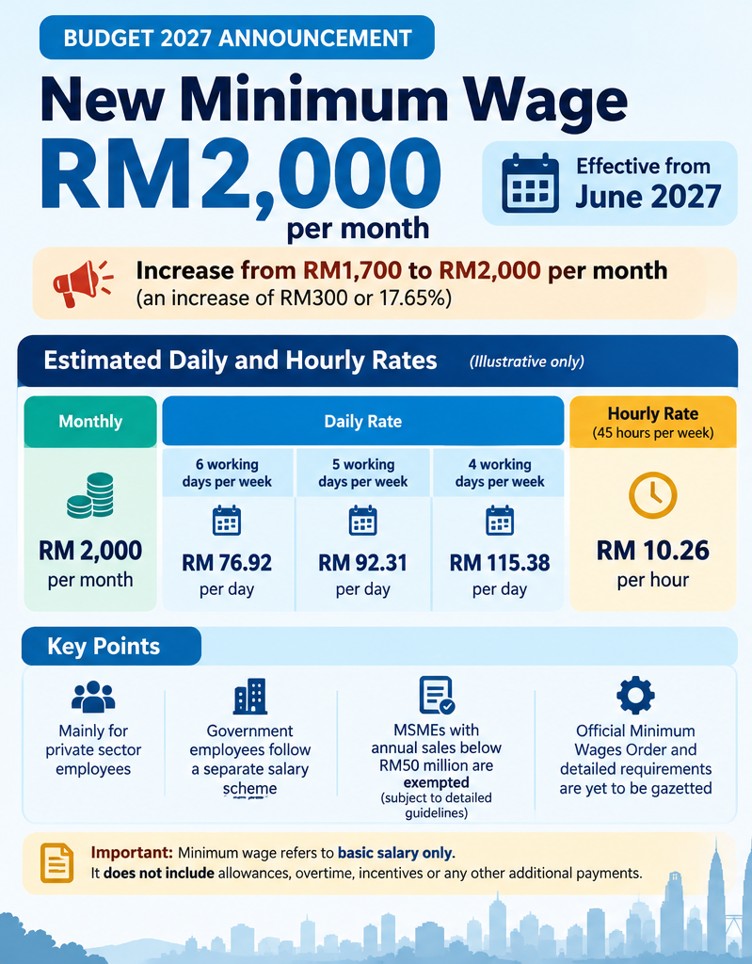
The Malaysian Government has announced an increase in the national minimum wage from RM1,700 to RM2,000 per month, effective June 2027, under Budget 2027.
The new minimum wage represents an increase of RM300, or approximately 17.65%, and is expected to benefit more than four million workers nationwide.
However, not all employers will be required to implement the new rate immediately. The Government has announced an exemption for micro, small and medium enterprises (MSMEs) with annual sales below RM50 million, allowing these businesses additional time to adjust.
1. Malaysia Minimum Wage 2027 – Key Changes
| Item | Details |
| Current minimum wage | RM1,700 per month |
| New minimum wage | RM2,000 per month |
| Increase | RM300 (17.65%) |
| Effective date | June 2027 |
| MSME exemption | Annual sales below RM50 million, subject to detailed guidelines |
| Official Minimum Wages Order | Awaiting publication |
The RM2,000 rate is an announced policy. Employers should refer to the forthcoming gazetted Minimum Wages Order for legally confirmed requirements.
2. Who Must Comply With the RM2,000 Minimum Wage?
The new minimum wage is intended primarily for employees in Malaysia’s private sector.
Based on the Budget 2027 announcement, larger businesses that do not qualify for the MSME exemption should prepare to implement the RM2,000 minimum wage from June 2027.
The existing minimum wage framework generally covers both Malaysian and foreign employees in the private sector, subject to applicable statutory exclusions.
Civil servants are governed by separate public-service remuneration arrangements and are not automatically covered by the same minimum wage order.
3. Are MSMEs Exempted From the RM2,000 Minimum Wage?
Yes. Under Budget 2027, the Government announced that MSMEs with annual sales below RM50 million will be exempted from the increase to give them time to adjust their business models.
However, the exemption is not necessarily permanent. Its duration, qualification requirements and eventual implementation schedule have not yet been fully clarified.
Important: Employers should not assume that having fewer than 200 employees automatically qualifies them for the exemption. The specific wage exemption conditions must be confirmed against KESUMA’s forthcoming guidelines.
4. What Qualifies as an MSME in Malaysia?
According to SME Corporation Malaysia, businesses are classified as micro, small or medium enterprises based on their annual sales turnover OR number of full-time employees.
SME Corp Malaysia – Overall Classification
| Sector | Annual sales turnover | Full-time employees |
| Manufacturing | Not exceeding RM50 million | OR not exceeding 200 |
| Services and other sectors | Not exceeding RM20 million | OR not exceeding 75 |
A business generally needs to satisfy either one of the qualifying criteria, subject to registration, ownership and other eligibility conditions.
Detailed MSME categories
| Category | Manufacturing | Services & other sectors |
| Micro | Sales below RM300,000 OR fewer than 5 employees | Same |
| Small | Sales RM300,000 to below RM15 million OR 5–74 employees | Sales RM300,000 to below RM3 million OR 5–29 employees |
| Medium | Sales RM15 million to RM50 million OR 75–200 employees | Sales RM3 million to RM20 million OR 30–75 employees |
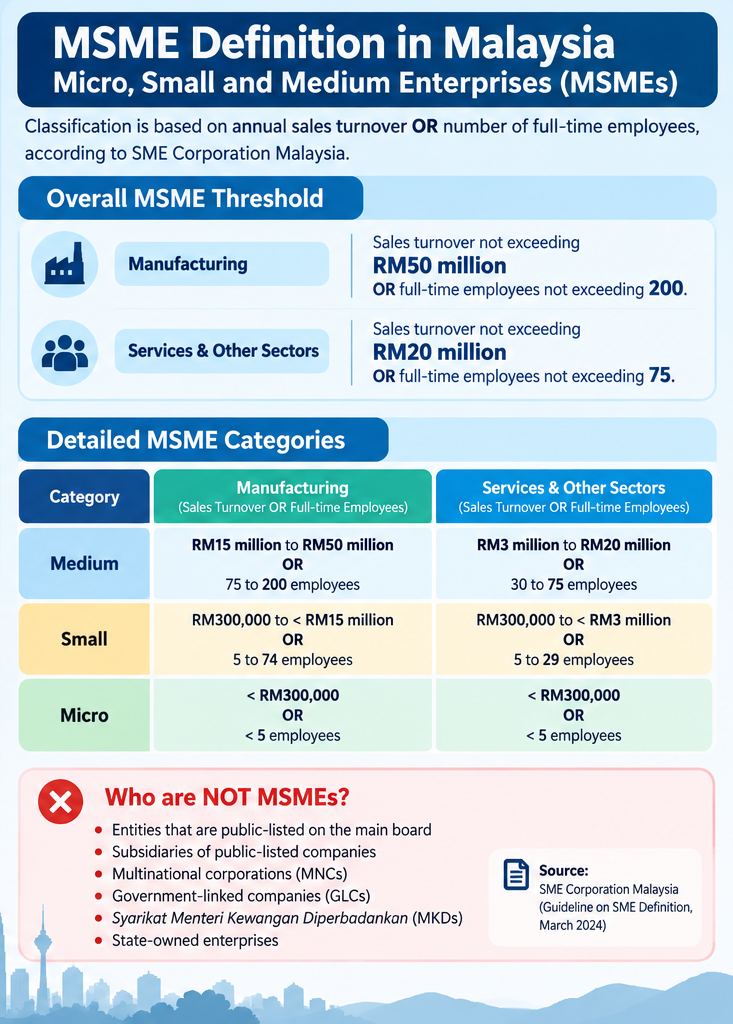
The classification also excludes certain entities, including companies listed on the Main Market and subsidiaries of multinational corporations, government-linked companies and certain other large organisations.
Source: SME Corporation Malaysia – Official SME Definition.
Does SME classification automatically qualify a company for exemption?
Not necessarily.
SME Corp’s general definition uses either turnover or employee count. However, the Budget 2027 wage announcement specifically refers to MSMEs with annual sales below RM50 million.
For example, a manufacturing company with RM55 million annual sales but only 100 employees might satisfy SME Corp’s employee-count criterion. That does not automatically establish eligibility for the minimum wage exemption.
Employers should wait for the official implementation guidelines before making a final determination.
5. Minimum Wage 2027 – Estimated Daily and Hourly Rates
Based on the proposed RM2,000 monthly minimum wage, the following daily and hourly rates may be used for preliminary payroll budgeting.
| Wage category | Estimated rate |
| Monthly | RM2,000.00 |
| Daily – 6 working days/week | RM76.92 |
| Daily – 5 working days/week | RM92.31 |
| Daily – 4 working days/week | RM115.38 |
| Hourly – based on 45 hours/week | RM10.26 |
These estimates use the annualised calculation:

Disclaimer: These are illustrative calculations, not official statutory rates. The final daily and hourly minimum wage rates must be confirmed against the gazetted Minimum Wages Order 2027.
6. Does Minimum Wage Include Allowances and Overtime?
No. Under Malaysia’s existing minimum wage framework, minimum wage refers to an employee’s basic salary, excluding allowances and additional payments.
For example:
| Salary component | Amount |
| Basic salary | RM1,800 |
| Transport allowance | RM200 |
| Attendance allowance | RM100 |
| Total gross salary | RM2,100 |
Although the employee receives RM2,100 in total, the basic salary is only RM1,800.
If the RM2,000 minimum wage applies to this employee, the employer would need to increase the basic salary to at least RM2,000. The allowances cannot simply be counted towards meeting the minimum wage requirement.
7. What About Part-Time and Hourly-Paid Employees?
Employers should also review employees paid on an hourly or daily basis, including part-time workers.
The current Minimum Wages Order 2024 prescribes an hourly minimum of RM8.72. The estimated RM10.26 hourly rate for 2027 is for budgeting purposes only and should not yet be treated as the official statutory rate.
Part-time employment arrangements must also comply with applicable employment legislation and minimum wage requirements.
8. What About the RM2,500 Minimum Wage for Graduates and Semi-Skilled Workers?
Budget 2027 also announced plans to introduce a minimum monthly wage of RM2,500 for semi-skilled workers and graduates as part of a broader wage reform.
However, the Government has yet to fully clarify the eligibility criteria, covered occupations and implementation mechanism.
Employers should therefore avoid assuming that every graduate employee must immediately receive RM2,500 from June 2027.
9. How Should Employers Prepare for the Minimum Wage Increase?
Although June 2027 is still several months away, employers should begin reviewing their payroll and salary structures.
Recommended preparation steps include:
- Review employee basic salaries: Identify employees currently earning below RM2,000.
- Check MSME eligibility: Review annual sales, employee headcount, business classification and ownership structure.
- Estimate additional payroll costs: Consider not only the RM300 salary increase but also any resulting changes in employer statutory contributions.
- Review hourly and daily wage rates: Identify part-time and daily-paid employees who may be affected.
- Update payroll systems: Prepare for changes to salary rates and relevant payroll calculations once official requirements are confirmed.
- Monitor official announcements: Follow KESUMA and the gazetted Minimum Wages Order for implementation details.
10. Frequently Asked Questions
Q1. Is the RM2,000 minimum wage compulsory from January 2027?
No. The announced effective date is June 2027, not January 2027.
Q2. Does a company with fewer than five employees need to comply?
Under the existing framework, the RM1,700 minimum wage applies to employers regardless of headcount. Whether the company qualifies for the new MSME exemption will depend on the 2027 implementation rules.
Q3. If my company has annual sales below RM50 million, can I continue paying RM1,700?
The Government has announced an exemption for qualifying MSMEs with annual sales below RM50 million. However, the detailed conditions and duration are still pending. Employers must continue meeting the existing RM1,700 minimum wage requirement.
Q4. Does the minimum wage apply to foreign workers?
Under the current framework, foreign employees in the private sector are generally covered, subject to statutory exclusions. The 2027 order will confirm the applicable scope.
Q5. Is the RM2,000 minimum wage calculated based on gross salary?
No. Under the existing framework, it is based on basic salary, excluding allowances and additional payments.
Conclusion
The increase in Malaysia’s minimum wage to RM2,000 from June 2027 is an important development for employers and employees.
While qualifying MSMEs have been granted an exemption to allow more time for adjustment, employers should not assume that the exemption is permanent or that all businesses with fewer than 200 employees automatically qualify.
For now, the existing RM1,700 minimum wage remains applicable, and employers should prepare for the upcoming changes while awaiting the official Minimum Wages Order and detailed implementation guidelines.
At CentralHR, we help Malaysian businesses manage payroll processing, statutory compliance and HR administration. Employers who require assistance reviewing their payroll arrangements or preparing for upcoming regulatory changes may contact us at centralhr.my.
Official references
- Ministry of Finance – Budget 2027 Speech
- SME Corp Malaysia – SME Definition
- SME Corp – Guideline on SME Definition
Disclaimer: This article reflects publicly available information as at 14 October 2026. The 2027 minimum wage rates, exemptions and implementation details remain subject to the forthcoming gazetted order and official guidelines.
