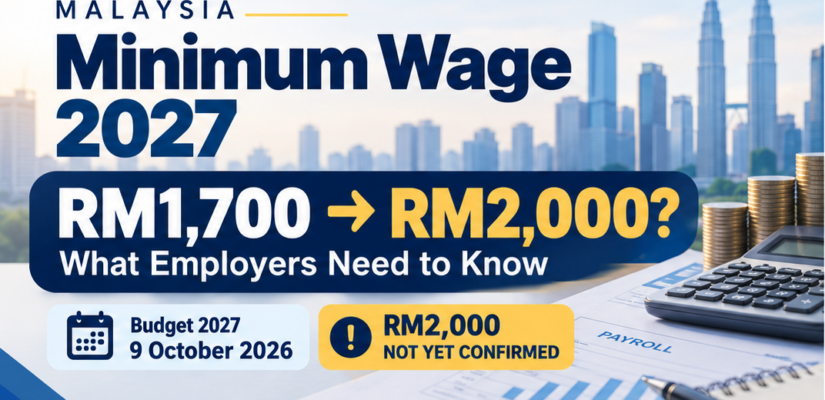
Malaysia Minimum Wage 2027: Will RM1,700 Increase to RM2,000?
Malaysia’s minimum wage is back in the spotlight ahead of Budget 2027, following discussion over a possible increase from the current RM1,700 to RM2,000 per month.
However, employers should take note that RM2,000 has not been officially confirmed as Malaysia’s new minimum wage.
As at 29 September 2026, the statutory minimum wage remains RM1,700 per month under the Minimum Wages Order 2024. Ministry of Human Resources Malaysia
The Government is expected to provide further details on wage-related initiatives when Budget 2027 is tabled in Parliament on 9 October 2026.
Is Malaysia’s Minimum Wage Increasing to RM2,000?
Not yet.
On 28 September 2026, Economy Minister Akmal Nasrullah Mohd Nasir said that any decision on a possible increase in the minimum wage to RM2,000 should be left to the Prime Minister’s announcement when Budget 2027 is tabled.
He also said that the Government is considering the impact of any adjustment on different categories of employers, particularly micro, small and medium enterprises (MSMEs), and their ability to absorb higher operating costs.
This means that while RM2,000 is being discussed as a possible new minimum wage, it is not currently a statutory requirement.
Employers should therefore continue applying the existing minimum wage until an official change and its effective date are announced.
What Is the Current Minimum Wage in Malaysia?
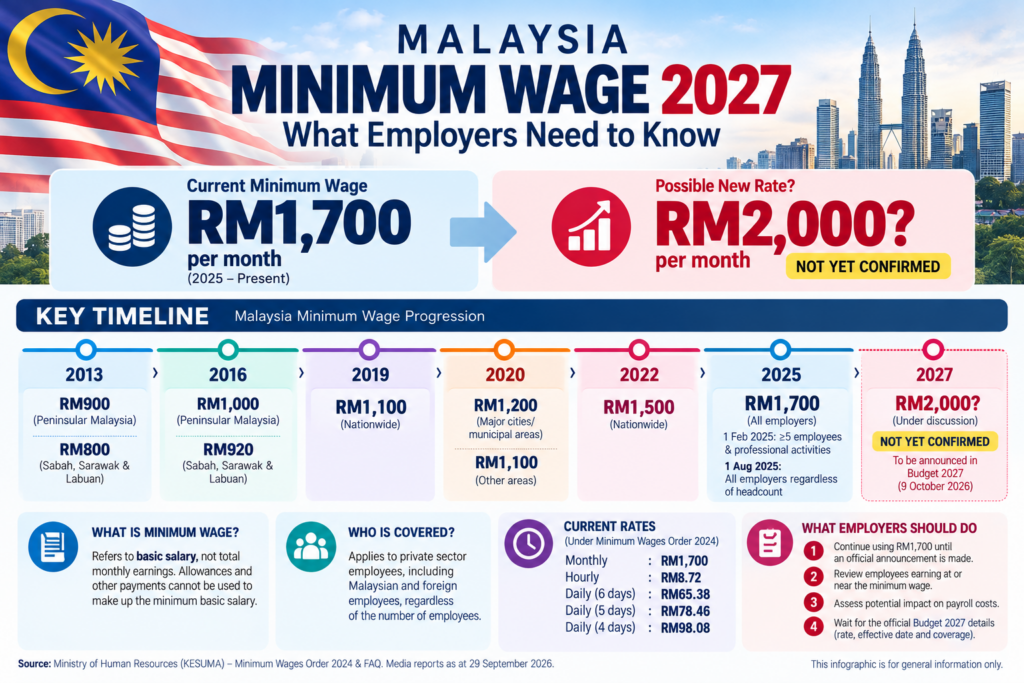
Malaysia’s current minimum wage is RM1,700 per month.
Under the Minimum Wages Order 2024, the applicable rates are:
| Wage basis | Current minimum wage |
| Monthly | RM1,700.00 |
| Hourly | RM8.72 |
| Daily – 6 working days/week | RM65.38 |
| Daily – 5 working days/week | RM78.46 |
| Daily – 4 working days/week | RM98.08 |
These are the official rates stated in KESUMA’s Minimum Wages Order 2024 FAQ. Ministry of Human Resources Malaysia
The RM1,700 rate initially took effect on 1 February 2025 for employers with five or more employees and employers carrying out professional activities regardless of headcount.
For employers with fewer than five employees, the RM1,700 rate subsequently took effect on 1 August 2025.
Therefore, the RM1,700 minimum wage now applies regardless of whether an employer has fewer than five employees.
Minimum Wage Means Basic Salary
This is an important point for payroll purposes.
Employers should not look only at an employee’s total gross salary when determining compliance with the minimum wage.
KESUMA states that employers must ensure employees receive a basic wage of at least RM1,700 per month.
For example:
Employee A
Basic Salary: RM1,700
Transport Allowance: RM200
Gross Salary: RM1,900
The basic salary meets the current minimum wage.
Employee B
Basic Salary: RM1,500
Fixed Allowance: RM300
Gross Salary: RM1,800
The employee’s gross salary may be above RM1,700, but the basic salary remains below the statutory minimum.
Employers should therefore review the basic salary component rather than simply checking whether total monthly earnings exceed RM1,700.
Can an Employee Agree to a Salary Below RM1,700?
No.
KESUMA’s official FAQ states that an employer cannot pay a basic salary below the applicable minimum wage even where the employee agrees to the lower amount.
Doing so can constitute an offence under the National Wages Consultative Council Act 2011.
An employment contract stating that the employee has voluntarily agreed to a lower salary therefore does not override the statutory minimum wage requirement.
Does the Minimum Wage Apply to Foreign Workers?
The Minimum Wages Order generally applies to private-sector employees covered by the Order and is not limited to Malaysian employees.
This means employers should also review the basic salaries of their foreign employees when checking minimum-wage compliance.
Employers should not assume that a lower basic salary can be paid simply because an employee is a foreign worker.
What Would an Increase to RM2,000 Mean?
If the Government eventually increases the minimum wage from RM1,700 to RM2,000, the increase would be:
RM300 per employee per month
That represents approximately a 17.6% increase in the minimum basic salary.
For an employer with 20 employees currently earning RM1,700:
RM300 × 20 employees = RM6,000 additional basic salary per month
Over 12 months:
RM6,000 × 12 = RM72,000 additional basic salary per year
And that is before considering other salary-linked employment costs.
Depending on the employee and applicable contribution rules, a higher basic salary may also affect employer costs relating to statutory contributions and other salary-linked benefits.
So for employers with a large number of employees earning at or close to minimum wage, the financial impact can be significant.
Why Is the Government Looking at Wages Again?
Wage growth is one of the areas being highlighted ahead of Budget 2027.
On 27 September, Prime Minister Anwar Ibrahim said that wages remained low despite increases in productivity and corporate profits, and indicated that initiatives addressing wage and income issues would be announced in the upcoming Budget.
The Ministry of Finance’s Pre-Budget Statement 2027 also identifies workers’ welfare and decent wages as a priority.
It says sustainable wage growth needs to be supported by productivity gains, skills development, digitalisation and a move towards higher-value economic activities.
The discussion therefore goes beyond simply changing the statutory minimum wage. The Government is also looking at broader measures intended to improve wages, productivity and career progression.
What Should Employers Do Now?
There is no need to change payroll systems to RM2,000 at this stage.
Until a new minimum wage is officially announced and becomes effective, employers should continue complying with the current RM1,700 requirement.
However, companies can start preparing for the possibility of an increase.
Employers may want to:
- Identify employees earning RM1,700 or close to the minimum wage.
- Estimate the payroll impact if the minimum wage increases to RM2,000.
- Consider the effect on salary-linked statutory contributions and employment costs.
- Review salary compression, particularly where supervisors or more experienced employees currently earn only slightly above RM2,000.
- Wait for the official announcement before making statutory payroll changes.
The salary-compression point is particularly important.
For example, if a junior employee currently earns RM1,700 while a senior employee earns RM2,100, increasing the junior employee to RM2,000 would leave only a RM100 difference.
An employer may therefore need to consider whether adjustments are required elsewhere in its salary structure, rather than budgeting only for employees currently earning RM1,700.
What Should Employers Look Out for in Budget 2027?
Budget 2027 is scheduled to be tabled in Parliament on 9 October 2026. Ministry of Finance Portal
If a new minimum wage is announced, employers should not focus only on the headline amount.
There are several details that will matter for payroll implementation, including the new minimum wage rate, effective date, hourly and daily rates, employee coverage, whether implementation will be phased, and whether different effective dates will apply to different categories of employers.
An announcement during Budget 2027 also does not necessarily mean that a new rate becomes effective immediately.
Employers should wait for the Government’s official implementation details and, where applicable, the relevant gazetted order.
Is RM2,000 Confirmed for 2027?
No. As at 29 September 2026, RM2,000 has not been confirmed as Malaysia’s new statutory minimum wage.
The current statutory rate remains RM1,700 per month.
The RM2,000 figure is being publicly discussed, and Economy Minister Akmal Nasrullah has said that any decision on the possible increase should be left to the Budget 2027 announcement.
Employers should therefore be careful with social-media posts or graphics stating that Malaysia’s minimum wage “will be RM2,000” before an official announcement is made.
For now, a more accurate description is:
Current minimum wage: RM1,700
Possible 2027 minimum wage: RM2,000?
Status: Not yet confirmed
Budget 2027: 9 October 2026
CentralHR Will Monitor the Budget 2027 Announcement
Any change in the minimum wage can affect more than an employee’s basic salary. Employers may also need to update payroll systems, employment contracts, salary structures and payroll budgets.
CentralHR will provide an update following the Budget 2027 announcement on 9 October 2026 if there are changes affecting Malaysia’s minimum wage.
CentralHR provides payroll outsourcing, HRMS and HR support services in Malaysia, helping businesses manage monthly payroll processing, statutory requirements and payroll compliance.
For assistance with your company’s payroll or HR requirements, contact CentralHR.
Disclaimer: This article is provided for general information only and is based on information available as at 29 September 2026. It should not be regarded as legal advice. Employers should refer to the relevant gazetted order and official Government announcements for the final minimum wage rate, effective date and implementation requirements.
