PERKESO Job Vacancy Reporting Malaysia 2026
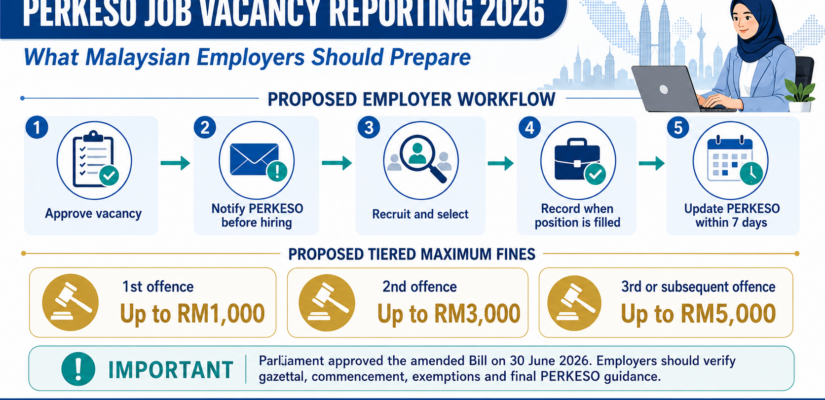
Malaysia plans to introduce a job-vacancy reporting requirement through PERKESO. Under the proposal, an employer would report a vacant or newly created position before hiring. The employer would then update PERKESO after the position is filled.
Parliament approved the amended Bill on 30 June 2026. The approved changes include lower, tiered fines. Business groups have asked the government to start with voluntary reporting, education and warnings, especially for smaller employers.
However, a request from business groups does not change the approved Bill. Employers must also remember that parliamentary approval is not the same as commencement. The final Act, effective date, exemptions and reporting procedure must still be checked through official sources.
Quick answer: Prepare the reporting process now, but verify the official commencement date and final PERKESO rules before stating that the new requirement is already enforceable. |
At a Glance
Question | Simple answer |
|---|---|
What may need to be reported? | A vacant or newly created position. |
When? | Before hiring the employee. |
What happens after hiring? | Update PERKESO within seven days after the position is filled. |
Where? | The final process is expected to involve PERKESO or MYFutureJobs. |
Is it already in force? | Check the gazette, commencement date and official PERKESO notice. |
Proposed maximum fines? | RM1,000, RM3,000 and RM5,000 for repeated offences. |
What Has Parliament Approved?
Parliament lists the Employment Insurance System (Amendment) Bill 2025 as D.R.33/2025. The Dewan Rakyat first passed it in December 2025. The Dewan Negara changed the penalty provision in March 2026. The Dewan Rakyat accepted that change on 30 June 2026.
The main proposal is a new Section 45F. It would require an employer to tell PERKESO about a vacancy or new position before hiring. After the position is filled, the employer would provide another update within seven days.
Stage | Reported development |
|---|---|
4 November 2025 | First reading of the Employment Insurance System (Amendment) Bill 2025 in the Dewan Rakyat. |
2 December 2025 | Dewan Rakyat passed the original Bill, which proposed a maximum RM10,000 fine. |
12 March 2026 | Dewan Negara approved an amendment introducing progressive penalties. |
30 June 2026 | Dewan Rakyat approved the Dewan Negara amendment. |
Next legal steps | Royal Assent, publication and commencement must be checked in the official gazette and PERKESO implementation notices. |
Proposed Employer Duties Under Section 45F
1. Notify PERKESO before hiring
The proposal covers replacement vacancies and new positions. For example, it may cover a role left vacant after a resignation and a completely new role approved by management. The final rules may provide exemptions or more detailed definitions.
2. Update PERKESO after the position is filled
The employer would also update PERKESO within seven days after the position is filled. Until PERKESO explains exactly when a position is treated as filled, HR should record the offer-acceptance date, contract-signing date and first working day.
3. Keep an auditable recruitment record
Keep a simple audit trail. Save the vacancy approval, submission date, acknowledgement number, advertisements, accepted offer, start date and filled-status update in the recruitment file.
What Are the Proposed Penalties?
Offence | Maximum fine approved by Parliament |
|---|---|
First offence | RM1,000 |
Second offence | RM3,000 |
Third or subsequent offence | RM5,000 |
These amounts replace the original proposed maximum fine of RM10,000. The government has said that education, guidance and compliance notices will be important, and that prosecution should be a last resort. However, employers should not assume that every first mistake will receive only a warning. The final enforcement rules will matter.
Compliance note: The figures are maximum fines in the amended Bill approved by Parliament. Confirm that the final Act and commencement provisions retain the same amounts before publishing an unqualified statement that the fines are currently enforceable. |
Why Are Business Groups Asking for Voluntary Reporting?
The Star reported concerns from ACCCIM, Samenta and the Malaysian Food Manufacturers Association. They said compulsory reporting could duplicate work, slow urgent hiring and create extra administration for small businesses without dedicated HR staff.
They asked the government to begin with voluntary use, education, incentives and warnings. This is their recommendation. It is not a legal exemption. Employers must follow the final law once it starts.
Will SMEs Be Exempt?
In December 2025, the Human Resources Minister said PERKESO planned to exempt SMEs, subject to consultation. He also referred to a two-year moratorium before enforcement. These were announced plans, not the final exemption rules. Employers must check the official definition, conditions and effective date.
An employer that may qualify as an SME should still prepare basic vacancy records and register for MYFutureJobs where useful. This avoids a rushed implementation if the exemption is narrower than expected or temporary.
Is MYFutureJobs the Reporting Platform?
MYFutureJobs is PERKESO’s national employment platform. Employers can post jobs and use its matching services. It is expected to play a central role in vacancy reporting, but employers should follow the final method prescribed by PERKESO and save the acknowledgement.
Posting on JobStreet, LinkedIn, an employer’s career page or through a recruitment agency should not be assumed to satisfy a PERKESO notification duty. A company may continue using those channels, but the MYFutureJobs/PERKESO step should be built into the recruitment workflow if and when required.
Vacancy Reporting Is Not the Same as Expatriate Advertising
Employers hiring expatriates or foreign workers may already use MYFutureJobs for immigration or labour-market testing. Those processes may require advertising periods, interviews, recommendations or exemptions. The proposed Section 45F reporting duty is separate and may not replace them.
For an expatriate role, HR may therefore need to satisfy both the general vacancy-reporting framework and the applicable immigration advertising or approval process. CentralHR recommends keeping the evidence in one recruitment compliance file while tracking each legal basis separately.
Five Real-Life Employer Scenarios
Scenario 1: Urgent retail replacement
A cashier resigns without notice and the outlet needs a replacement immediately.
Recommended action: Create and submit the vacancy record before completing the hire. Urgency should be documented but should not be treated as an automatic exemption unless official rules say so.
Scenario 2: Newly created software role
Management approves a new developer position that did not previously exist.
Recommended action: Treat the new headcount as potentially reportable, not only conventional vacancies caused by resignation.
Scenario 3: Recruitment agency appointment
A company asks an agency to source candidates and assumes the agency will handle PERKESO reporting.
Recommended action: State responsibility in the engagement letter, but the employer should verify the submission and retain the acknowledgement.
Scenario 4: SME expecting an exemption
A 20-person business reads that SMEs may be exempt.
Recommended action: Check the final legal definition and effective notice. Until confirmed, prepare the workflow and avoid relying only on a newspaper report.
Scenario 5: Expatriate key position
A company is recruiting a specialist from overseas and completes an immigration-related MYFutureJobs process.
Recommended action: Map the immigration requirements and the general vacancy notification separately; retain evidence that each applicable requirement was completed.
Employer Action Plan
Action 1: Monitor official commencement
Assign one person to monitor the Federal Gazette, PERKESO’s Act and Regulations page, MYFutureJobs employer notices and Ministry of Human Resources announcements. Record the source and verification date. Do not rely solely on social posts or vendor summaries.
Action 2: Build the control before enforcement
Add two fields to the recruitment tracker: “PERKESO vacancy notified” and “filled status updated”. Make the first a prerequisite before final hiring approval, subject to confirmed exemptions, and create a time-based reminder for the second.
Action 3: Test with voluntary reporting
Where practical, use MYFutureJobs now to familiarise HR with employer registration, job-posting fields and candidate matching. A pilot can reveal ownership and data-quality issues before a statutory deadline applies.
Action 4: Update policies and contracts
Update the recruitment SOP and agency terms to specify who submits, who checks, what evidence is retained and how quickly the employer receives the vacancy ID. The employer should maintain oversight even when a third party performs the submission.
Key Takeaways
- Parliament approved the amended Bill and progressive penalty structure on 30 June 2026.
- The proposed duty covers vacancies and newly created positions before hiring, plus a filled-status update within seven days.
- First, second and later offences carry proposed maximum fines of RM1,000, RM3,000 and RM5,000 respectively.
- Business groups have asked for voluntary, education-first implementation, but that request is not itself a legal exemption.
- Employers must check gazettal, commencement, exemptions and final PERKESO procedures.
- Preparing a MYFutureJobs workflow and audit trail now is a low-risk compliance step.
Frequently Asked Questions
1. Is PERKESO vacancy reporting mandatory now?
Parliament has approved the amended Bill, but employers should confirm that the amending Act has received Royal Assent, been gazetted and commenced. Check current PERKESO guidance before treating the duty and penalties as operational.
2. What is Section 45F?
It is the proposed new provision requiring an employer to notify PERKESO of a vacancy or newly created position before hiring and to notify PERKESO after it is filled.
3. Must every vacancy be reported?
The Bill uses broad wording, but final regulations, exemptions and guidance may define the covered employers, sectors and positions. Do not assume every role or an exemption until the official scope is published.
4. Are newly created positions included?
Yes, the proposed wording expressly refers to both a job vacancy and a new position.
5. When must the first notification be made?
The proposed duty is before hiring. Official guidance should clarify the precise event and required lead time.
6. What happens after the job is filled?
The employer would notify PERKESO in writing within seven days after the vacancy or new position is filled.
7. When is a position considered filled?
The final guidance should clarify whether this is offer acceptance, contract signing or commencement. Until then, retain all three dates and update promptly.
8. What are the proposed fines?
The approved tiered maximums are RM1,000 for a first offence, RM3,000 for a second offence and RM5,000 for a third or subsequent offence.
9. Is the old RM10,000 fine still the proposal?
No. The Dewan Negara amended the original penalty and the Dewan Rakyat approved the tiered structure on 30 June 2026.
10. Will employers receive a warning first?
Parliamentary reporting emphasised compliance notices, education and prosecution as a last resort. Employers should not assume a warning is guaranteed in every case unless the final enforcement rules provide it.
11. Are SMEs exempt?
An SME exemption and two-year moratorium were previously announced as intended measures subject to consultation. Employers must check the final legal instrument and eligibility criteria.
12. Must vacancies be posted on MYFutureJobs?
MYFutureJobs is PERKESO’s employment platform and is expected to be central to implementation. Follow the final prescribed channel and retain its acknowledgement.
13. Is a LinkedIn or JobStreet advertisement enough?
Do not assume so. Commercial advertising may continue, but it does not automatically equal notification to PERKESO.
14. Can a recruitment agency report for us?
Potentially, if the official system permits it, but the employer should assign responsibility in writing and verify the acknowledgement.
15. Does the rule apply to internal promotions?
The answer will depend on whether an internal opportunity is treated as a vacancy or new position under final guidance. Record the staffing movement and obtain clarification for ambiguous cases.
16. What about temporary or part-time positions?
The Bill summary does not provide every operational exclusion. Check final regulations for contract type, duration and other thresholds.
17. Is this the same as MYFutureJobs advertising for expatriates?
No. Immigration-related advertising and recommendation requirements have a different legal purpose. Both processes may apply to the same recruitment.
18. What evidence should an employer keep?
Keep the vacancy requisition, posting details, acknowledgement or vacancy ID, screenshots, candidate acceptance, employment start date and proof of the filled-status update.
19. Should employers wait before doing anything?
No. Employers can register on MYFutureJobs, test the workflow, update their recruitment tracker and monitor official notices without claiming that enforcement has started.
20. Where should employers verify updates?
Check the Federal Gazette, Parliament records, the Ministry of Human Resources, PERKESO’s official website and MYFutureJobs employer notices.
Conclusion
Malaysia’s proposed vacancy-reporting framework is a significant change to recruitment administration. The policy objective is to improve job matching and labour-market data, while employers are concerned about duplication, urgent hiring and the burden on smaller businesses. The revised tiered penalties and education-first statements respond to some of those concerns, but the final scope and implementation details remain decisive.
The prudent approach is to prepare, not panic. Build a simple vacancy-notification control, retain evidence and monitor the official commencement and exemption notices. This allows the business to comply quickly while avoiding inaccurate claims that a Bill or media report is already the complete operating law.
CentralHR supports Malaysian employers with payroll outsourcing, HR software, employment pass services and practical HR compliance solutions. Contact CentralHR if your organisation needs support in streamlining payroll, employee administration and statutory compliance processes.
